
上班这党事
23 humanoid robot teams compete in rescue missions at 2nd WHRG, facing real-world complexity beyond dancing in coordination_我的网站

一 |
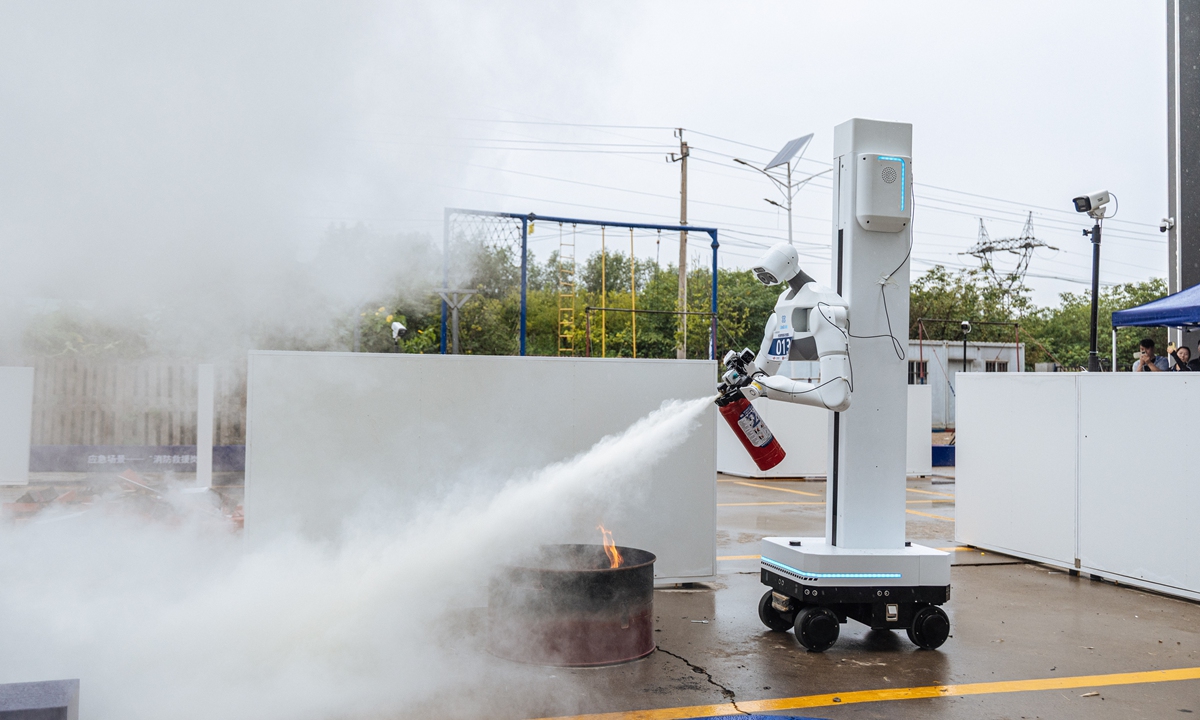
The firefighting final of the emergency management category at the 2nd World Humanoid Robot Games (WHRG) was held on Sunday in Beijing, putting 23 teams through a simulated rescue operation designed to test whether humanoid robots can move beyond demonstrations and perform practical tasks in complex real-world environments.
The event comes as Chinese humanoid robots, long known for eye-catching abilities such as running, dancing and music playing, are pushed toward practical applications, including jobs that are dangerous for humans such as emergency rescue.
Unlike the first edition of the WHRG last year, according to the organization committee, this year's scenario-based events emphasize "realistic simulation," with the firefighting competition being held at a fire brigade rather than in a model-room setup.
The competition simulated a firefighting assignment that required each of the 23 robots to complete three tasks within 30 minutes: identify hazardous materials, shut off valves and operate a fire extinguisher. For the first task, robots had to identify two randomly placed simulated hazardous substances and report their types to judges through returned images. They then had to locate three randomly selected open valves of different types and shut them off before identifying a fire source, finding a fire extinguisher and spraying it until the fire was put out.
Human firefighters were also involved in the event, lighting the fire and observing whether the robots carried out the extinguisher operation correctly.
The competition, however, showed how difficult it remains for robots to perform reliably outside controlled laboratory conditions.
Rain affected the competition, while changes in lighting and the outdoor environments added uncertainty to the robots' visual recognition and manipulation tasks. A team from UniX AI, a company well-known for its robot applications on real-world scenarios and has just raised a new round of 300 million yuan ($ 44.49 million) in late March, completed its run within the allotted time, but its robot moved relatively slowly compared to human firefighters' real practice. When operating the fire extinguisher, its robotic hand had to make two attempts to align with the target.
Of 12 teams competed on Sunday, three finished the challenge.
Yang Liqi, a representative of the UniX AI team, told the Global Times that the firefighting scenario placed higher demands on both the robot's recognition and manipulation capabilities.
"Rain and lighting conditions can affect the robot, and actual situations are often different from what we simulate in the laboratory," Yang said, noting that this was also one reason why a number of teams were unable to complete their runs on Sunday morning.
The team had programmed the robot to make up to three attempts when operating the extinguisher. "If it sees white smoke after the first attempt, it will not make a second attempt," Yang said.
The difficulty was not simply that whether the robot could move its arm. Humanoid robots rely on different types of joints for different tasks: small, high-precision joints enable delicate hand operations, while high-torque, reliable joints support movement and balance.
A failure at any point of actions and detection could affect the final result. This is precisely where the value of real-world competitions lies, Jin Chenran, a representative of the Tiangong team whose robot only accomplished one of the three tasks, told the Global Times.
"Whether the competition goes smoothly or not, that is the significance of a real-world simulation. Every real-world failure is valuable data that helps humanoid robots toward practical application," Jin said.
Jin further explained that questions like why the robot failed to recognize an object and how its motion-planning system selected the wrong path... Such data can subsequently be used to improve algorithms and train AI models.
The competition also offered a glimpse into the current transitional stage of humanoid robot technology. At the venue, some team members were wearing VR headsets and remotely adjusting their robots shortly before their runs.
Some humanoid robots were seen using omnidirectional wheels instead of feet, while their hands featured multiple joints to enable more precise manipulation. Many teams chose China-developed UBTECH's joint modules for their robots. Its servo actuators cover a wide torque range from 0.2Nm to 200Nm, allowing robots to combine dexterity with strength. Meanwhile, VR teleoperation gives operators a first-person view through the robot's cameras, enabling them to remotely guide movements in real time.
The event comes amid a broader push in China to move humanoid robots and embodied intelligence from laboratories and competition arenas into real production and daily-life environments. In June, the Ministry of Industry and Information Technology and the other departments launched a special program for humanoid robots and embodied intelligence that encouraged applications in practical fields including emergency rescue.
Zhao Weidong, deputy director of the organizing committee office, told the Global Times that the scenario-based competitions are intended to test the progress of humanoid robots from "competition performance" toward "real operational work," including whether they can eventually become intelligent partners for firefighters.
"At present, many simulations of actual operations may still be at an early stage," Zhao said. "But these are an important starting point for enabling robots to truly assist humans in real-world environments, as well as an important source of data and testing."
The ultimate goal, Zhao said, is to push robots into fields where human operations are dangerous and achieve genuine "human-robot complementarity."
。 「SF90」の後継モデルが「テスタロッサ」を名乗る理由。スペック競争の果てにフェラーリが見つけたものとは? アメリカのカーメディア『Road & Track』から。【写真56枚】フェラーリ 849テスタロッサ をあらゆる角度から見る テスタロッサの名が復活した理由の一部は、マラネロ流のちょっとした「目くらまし」といえるかもしれない。

二 | 新型テスタロッサの出自と、先代モデルとの共通点から目を逸らすためのものだ。

三 | 先代モデルである「SF90 ストラダーレ」は、ランボルギーニ「レヴエルト」やアストンマーティン「ヴァルハラ」といった3モーター・ハイブリッドの競合車よりも数年早く市場に投入された。傑作と呼べる車だったが、フェラーリが名車と呼ばれるために不可欠な情緒的なつながりを生み出すことには苦戦していた。そのことは、初期型の大幅な価値下落に現れている。視覚的には、849 テスタロッサは完全に新しいクルマだ。しかし、プラットフォームとパワートレインの両方をSF90と共有している。4.0リッター V8エンジンは、再設計されたシリンダーヘッドと、2基の低摩擦ターボチャージャーでアップデートされ、その大部分は低炭素リサイクルアルミニウムで作られている。エンジンの最高出力は819hp、最大トルクは621lb-ftへとわずかに向上した。

四 | これはSF90に比べて50hpと31lb-ftの増加にあたる。一方、電動部分のハードウェアに変更はない。

五 | 7.4kWhのバッテリーパックが、フロント左右のホイールにそれぞれ一つ搭載され、リアの大型アキシャルフラックスモーターに電力を供給する。3基のモーターによる最大217hpの電気アシストが加わることで、システム全体のピーク出力は1036hpに達する。さらに、完全なEVモード「eDrive」も用意された。これは時速80マイル(約128km/h)までの速度域に限られ、駆動はフロントの電気モーターのみで行われる。
Current article:http://ibnf.hanninhuaxituochunkui.pics/news/20260826_1989324.html
Published on:02:52:00


上班这党事TXT下载声明:
1 我的网站免费提供的上班这党事,均由网友上传,供下载测试之用,不作商业用途,下载后请二十四小时后删除!
2 我们根据txt小说全文所整理出上班这党事txt电子书全集免费下载,由程序自动生成上班这党事txt下载文件。
3 书友所发表的txt小说上班这党事的相关评论,并不代表本站赞同上班这党事txt下载或者支持上班这党事的读者观点。
4 如果发现小说《上班这党事txt全集》无法下载未及时更新请联系我们。如果您喜欢上班这党事txt电子书,请支持作者到书店购买正版图书。感谢您的合作与支持。
5 好看的小说上班这党事是作者"百年不渡"的最新力作,上班这党事电子书由网友发布;小说上班这党事版权属于作者所有,如果侵犯您的利益,请通知我们。