渴望
两岸青年媒体人辽宁行走进大连:以新媒体叙事讲好同根同源中华故事_我的网站

一 |
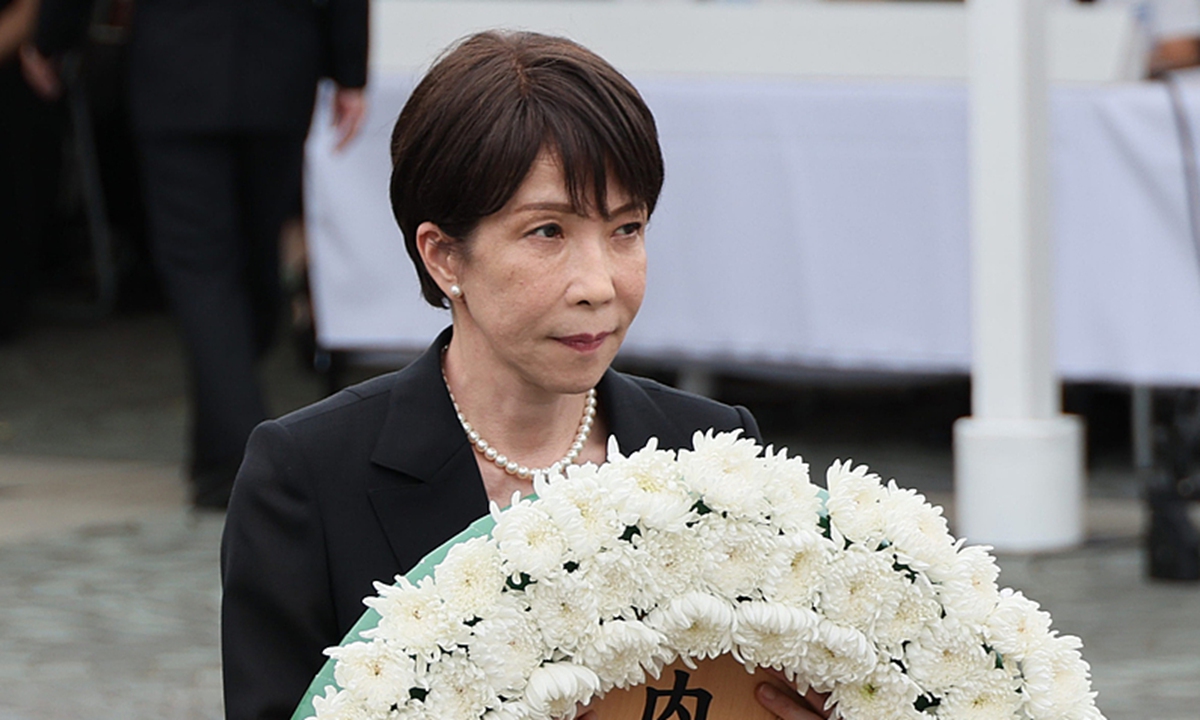
Japanese Prime Minister Sanae Takaichi attends a Nagasaki Peace Ceremony to commemorate the 81st anniversary of the atomic bombing at the Peace Park in Nagasaki City on August 9, 2026. Photo: VCGJapanese officials and members of the public urged the government to uphold the Three Non-Nuclear principles and pursue a security policy that does not rely on nuclear weapons, as Prime Minister Sanae Takaichi maintained an ambiguous stance on the long-held policy during a speech on Sunday marking the 81st anniversary of the US atomic bombing of Nagasaki.
Chinese experts noted that, similar to her ambiguous remarks at the memorial ceremony in Hiroshima, Takaichi stopped short of making a clear commitment to maintaining the Three Non-Nuclear Principles in the future, as her government's stance on nuclear issues has sparked concern and anger among the Japanese public. They also warned that, given Japan's lack of thorough reflection on its wartime aggression, Tokyo's moves to dilute the Three Non-Nuclear Principles should raise alarm across the international community.
"Our country firmly upholds the three non-nuclear principles, and under the pledge that 'Nagasaki shall be the last city to suffer a nuclear attack,' we are promoting realistic and practical initiatives toward the realization of a world without nuclear weapons," Takaichi claimed, according to the Japan Times.
But unlike previous prime ministers, many of whom had pledged that Japan would "continue to uphold" the principles, Takaichi merely described the government's current position without making an explicit commitment about the future, per the report.
As Hiroshima observed the 81st anniversary of the US atomic bombing of the city on Thursday, Takaichi also emphasized that Japan pledges to achieve a world free of nuclear weapons while upholding the Three Non-Nuclear Principles, despite Japanese media noting that she has left the door open for future revisions.
Takaichi's remarks in Hiroshima and Nagasaki that Japan upholds the three non-nuclear principles were largely seen as a reaffirmation of the country's existing policy position rather than a pledge to maintain the principles in the future, Liu Jiangyong, a professor at the Institute of International Studies at Tsinghua University, told the Global Times.
Liu said that currently, some Japanese officials' dangerous remarks on nuclear have sparked criticism among Japanese society. He pointed out that Takaichi only referred to Japan's current adherence to the principles, without explicitly committing to preserving them going forward. Her subsequent focus on broader goals such as achieving a "world without nuclear weapons" has further fueled questions over her actual policy intentions.
Japanese Defense Minister Shinjiro Koizumi claimed in an online program released in July that discussions on nuclear weapons were necessary to strengthen Japan's defense capabilities, according to Kyodo News. While acknowledging that the issue was difficult to discuss in Japan, he claimed it was something that "could not be avoided."
Opposition to the Takaichi administration's nuclear-related moves has emerged across Japan, including from local governments, media organizations and civil society groups.
According to statistics from the Japanese Diet, at least 128 local assemblies across the country had submitted written opinions to the central government or parliament between Takaichi's inauguration on October 21 last year and July 28 this year, calling for the country's Three Non-Nuclear Principles to be upheld, according to Xinhua News Agency.
In an interview with the AFP, 82-year-old Satoshi Tanaka, a campaigner who survived the 1945 attack on Hiroshima expressed frustration that current political leaders like Takaichi are focusing on military capacity at the expense of diplomacy.
"There is so much talk about national security. What about building peace through diplomacy?" he said.
Responding to a question concerning the Japanese authorities are rebuilding Japan's war machine, seeking to revise the Three Non-Nuclear Principles, and pursuing nuclear sharing with the US, even the possession of nuclear weapons, Chinese Foreign Ministry spokesperson Lin Jian said on Thursday that the devastation and tragedies brought by nuclear weapons should never repeat themselves. That said, the particular context of the nuclear explosions should all the more be remembered and the lessons of Japanese militarism's aggression and expansion must forever serve as an alarm.
The Tokyo's moves on nuclear policy have also raised concerns in the international community.
Russia considers the rhetoric of Japanese authorities regarding the need for Japan to revise its Three Non-Nuclear Principles provocative and unacceptable, Russian Ambassador to Japan Nikolai Nozdrev said in an interview with RIA Novosti, which was published on Saturday.
Responding to Koizumi's remarks on nuclear discussion, Nozdrev said "This is the first time in Japan's history, as the only country to have suffered atomic bombings in Hiroshima and Nagasaki, that a sitting defense minister has publicly called for lifting the 'taboo' on discussions related to nuclear weapons. We consider such rhetoric from official Tokyo provocative and absolutely unacceptable."
Japan has yet to fully reckon with its wartime aggression, thus any attempt by Tokyo to move toward acquiring nuclear weapons could pose serious risks to regional peace and global security, Lü Chao, an expert on the Korean Peninsula issue at the Liaoning Academy of Social Sciences, told the Global Times.
Such concerns have become more pronounced as Japan increasingly portrays China as a major security challenge while highlighting perceived threats from other countries, against such a backdrop, any further steps to dilute the three non-nuclear principles are likely to heighten concerns internationally, particularly among countries that suffered from Japanese aggression during World War II, said Lü.
。 中新网大连8月22日电 (记者 杨毅)21日至22日,参加“辽台同频 文媒共声——两岸青年媒体人辽宁行”的30余位媒体人士、青年自媒体人,走进辽宁省大连市,于山海之间感受海滨城市的独特魅力。
一行人漫步冰山慧谷文化创意园区,这里是大连冰山集团旧厂房原址,留存着一代大连人的城市记忆。旧工业基地经过精心改造,在保留原有基底的基础上融入现代设计,老旧厂房蜕变为兼具欧式建筑风貌、充满时尚感与科技感的智慧创新产业园,引得两岸媒体人纷纷驻足参观。
8月21日,两岸青年媒体人参观大连冰山慧谷。杨毅 摄
“这里不仅有历史痕迹,也有最时尚的现代色彩。”北师香港浸会大学副教授余为政在参观时感慨道。结合实地交流,他将此处与台北松山烟厂文创园区做对比,指出二者产业底色存在差异,松山烟厂属于轻工业改造项目,而冰山慧谷脱胎于重工业制造基地,但二者转型都非常成功。

二 |
8月21日,两岸青年媒体人参观大连冰山慧谷。杨毅 摄
行走在山海之间,两岸青年媒体人不时被眼前的美景吸引。在港东五街,起伏延伸的长街向着蔚蓝海面铺展,楼宇勾勒出天然画框,巨型轮船缓缓穿行其间;在威尼斯水城,欧式建筑伴着粼粼水波,大家举起相机、手机,定格下这座城市独有的浪漫图景。
“这里拥有良好的居住环境,是一座非常时尚的城市。”台湾自媒体博主王姵璇说,她要把这些美景通过短视频方式记录下来,让更多海外的观众了解大连。
一路采风、一路交流,两岸青年媒体人边走边聊,畅谈短视频创作思路,交流新媒体传播经验。在旅顺博物馆,两岸青年围绕文物背后的故事交流内容创作角度,探讨如何用年轻化、可视化的新媒体叙事,让中华优秀传统文化跨越海峡、深入人心。
此行参访覆盖沈阳、本溪、辽阳、大连四座城市,这也是台湾自媒体博主李明修第一次来到大连。一路走访,他真切感受到东北民众豪爽直率的性格,待人热忱坦荡。在旅顺博物馆,他了解到馆内不少珍贵文物是近代遭日军搜刮所得,部分文物还曾被劫掠转运日本,历经波折才回归馆藏。有感于先人遗物辗转流离,他感慨文物历经劫难留存于此实属不易,祖国日渐强大,才能守护文物不再遭劫掠流失。
8月22日,两岸青年媒体人抵达星海广场。 杨毅 摄
在旅顺清风小镇影视城,两岸青年媒体人探讨以年轻化、可视化新媒体叙事,传播中华优秀传统文化。

三 | 漫步星海广场,壮阔的城市海景令不少台湾青年媒体人心生感慨。

四 | 大家表示,未来将合力挖掘文化素材,打磨产出更多优质短视频作品,向两岸受众传递同根同源的中华文化。
大陆青年媒体从业者也表示,期待和台湾同行持续联动,深挖大连城市故事,借助新媒体搭建两岸民间交流桥梁,拉近两岸同胞距离,感受同根同源的文化底蕴。
据了解,本次活动旨在以媒体视角展现辽宁全面振兴成果,促进两岸青年交流交往,深化两岸同胞文化认同与情感联结,推动辽台各领域融合发展走深走实。(完)
【编辑:刘阳禾】。

五 |
Current article:http://ibnf.hanninhuaxituochunkui.pics/bg47jq/20260826/3794276.html
Published on:11:13:34